It happened during “Bloody December” 1943 along the Adriatic front in Italy during one of the most vicious battles of the war in a town called Ortona. Soldiers from the Canadian Loyal Edmonton Regiment and the Seaforth Highlanders Regiment were facing off against units from the renowned German 1st Parachute Division. This crack division comprised some of the most battle-hardened veterans in World War Two. What resulted was eight days (December 20th to 28th) of close quarter combat with both sides suffering heavy casualties.
The presence of war correspondents like Matthew Halton of the CBC made this bloody episode during the Italian campaign world famous. Radio listeners from Canada and around the world were treated to detailed descriptions of the fighting combined with the sounds of crashing shells and machine gun fire
In the middle of all this heavy fighting was a small event that celebrated the holiday season. In the Church of Santa Maria di Constandinopoli, the Seaforth Highlanders fusiliers were treated to a holiday dinner. Small groups of soldiers travelled a few hundred meters from where they were fighting to take part in this event.
"The setting for the dinner was complete, long rows of tables with white tablecloths, and a bottle of beer per man, candies, cigarettes, nuts, oranges and apples and chocolate bars providing the extras. The C.O., Lt.-Col. S. W. Thomson, laid on that the Companies would eat in relays... as each company finished their dinner, they would go forward and relieve the next company... The menu... soup, pork with apple sauce, cauliflower, mixed vegetables, mashed potatoes, gravy, Christmas pudding and mince pie... From 1100 hours to 1900 hours, when the last man of the battalion reluctantly left the table to return to the grim realities of the day, there was an atmosphere of cheer and good fellowship in the church. A true Christmas spirit. The impossible had happened. No one had looked for a celebration this day. December 25th was to be another day of hardship, discomfort, fear and danger, another day of war. The expression on the faces of the dirty bearded men as they entered the building was a reward that those responsible are never likely to forget… During the dinner the Signal Officer... played the church organ and with the aid of the improvised choir, organized by the padre, carols rang out throughout the church."
- Seaforth Highlanders Regiment, War Diary, December 25th, 1943
Shells bursting and machine gun fire could be heard by those participating in the feast. Soldiers died coming to and going from the dinner, for some it would be their last meal on earth.
On December 28 th, German paratroopers abandoned Ortona to the Canadians. It was a costly victory. Allied casualties numbered nearly 650 officers and men off all ranks. Almost 300 of those were Canadians.
Some 55 years later (Christmas 1998) German veterans joined their former Canadian foes at the very same church in re-enacting that unlikely Chirstmas time event.
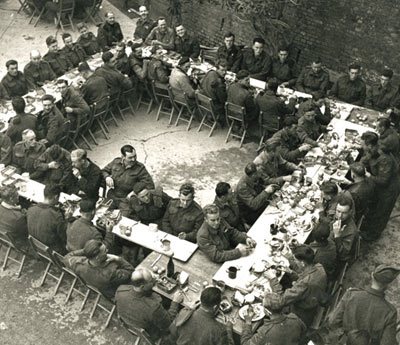
Christmas dinner December 25th, 1943 in Ortona.
Related Links
Return to Ortona - David Halton
Battle of Ortona - Juno Beach Centre
|








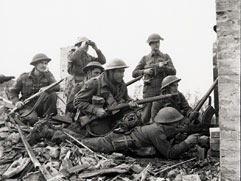
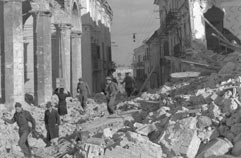 Ortona suffered severe damage during the eight day battle.